Title
Excerpt
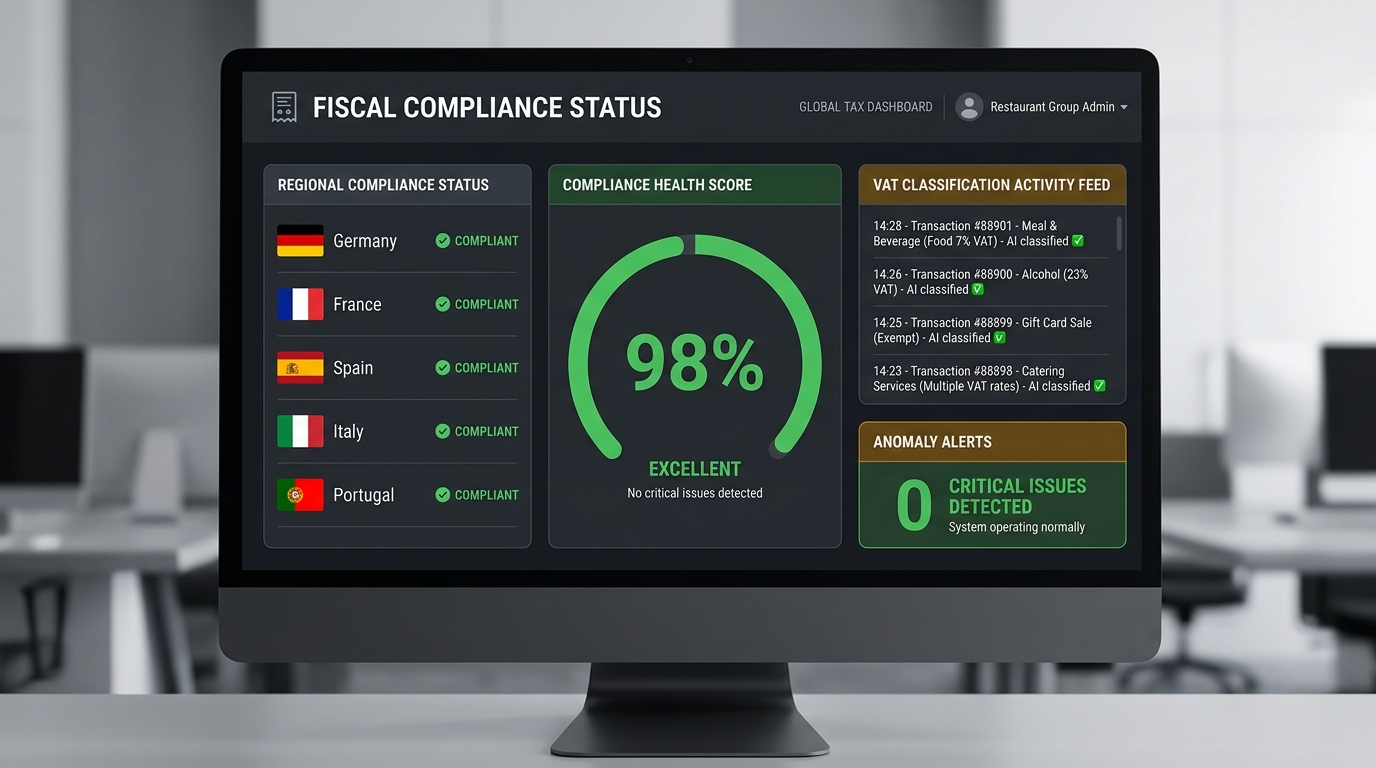
If you run a small restaurant in Germany — a Döner counter, a neighbourhood pizzeria, a busy café — you have probably heard of KassenSichV and TSE in passing. Maybe your Steuerberater mentioned them once. Maybe a POS salesperson waved a certificate. But when margins are already thin and the dinner rush never stops, compliance feels like someone else's problem until it is not. This guide explains, in plain language, what KassenSichV actually requires, what a Technische Sicherheitseinrichtung (TSE) does, how cloud signing works for small kitchens, and how to stay audit-ready without juggling a second vendor on top of your POS.
Why KassenSichV matters more for thin-margin kitchens
German hospitality runs on tight arithmetic. Ingredients, labour, rent, and utilities consume most of every euro before you reach anything resembling profit. Compliance is not an abstract legal topic in that environment — it is a line item that can become a fine, a back-payment demand, or a forced shutdown of your recording system if you get it wrong. KassenSichV (Kassensicherungsverordnung) exists to make sure every recorded sale is genuine, traceable, and tamper-evident. For a high-volume Imbiss or delivery-heavy pizza shop processing hundreds of tickets a week, the volume of signed transactions is exactly what makes both proper setup and sloppy habits costly.
Owners often postpone compliance work because it does not feel urgent on a Tuesday lunch shift. Tax authorities and auditors think in years, not shifts. The gap between "we will fix it next month" and "the Prüfer is here" is where most painful surprises live. Treating fiscal recording as part of your operating system — not a bolt-on you revisit once a year — is how thin-margin businesses avoid expensive fire drills.
KassenSichV is not a tax on success. It is a rule about honesty in recording. The restaurants that struggle are rarely the ones trying to cheat; they are the ones whose tools, habits, and vendor stack never made compliance the default path.
What KassenSichV actually requires
At a practical level, KassenSichV requires that businesses which must keep accounts (buchführungspflichtig) use an electronic recording system (ERE) that meets defined security standards, and that each relevant transaction is signed by a certified TSE. The goal is simple to state and demanding to implement: no sale should be alterable after the fact without leaving evidence, and auditors should be able to verify the chain of receipts.
For restaurant operators, the important outputs are familiar even if the law is not:
- Properly signed receipts (Belege) for cash and card sales, with the fiscal signature data required on customer and kitchen copies where applicable.
- A complete transaction log that can be exported for audit — often discussed as the DSFinV-K format in Germany.
- End-of-day closing (Z-Bon / Tagesabschluss) that reconciles what the system recorded with what you believe you sold.
- Retention and handoff so your Steuerberater can work from consistent data.
You do not need to memorise every paragraph of the ordinance to run a compliant kitchen. You do need a system that implements it correctly by default and staff habits that do not undermine what the system records.
Regulations evolve, and your Steuerberater should flag material changes. Your job as operator is narrower but non-negotiable: ensure the system you use is certified for the functions you rely on, keep it updated, and never bypass it with informal workarounds during service — no matter how busy the queue is.
What a TSE is and what it signs
A TSE is a certified security module — physical or cloud-based — that cryptographically signs each transaction at the moment it is recorded. Think of it as a notary stamp applied automatically to every sale. The signature proves that the transaction existed at a specific time with specific amounts, and that the record has not been silently edited afterward.
Every channel that records revenue may need signing: counter POS, table QR orders, takeaway terminals, and sometimes specific refund or void flows depending on configuration. If a ticket exists in your reporting but was never signed, or was signed with a gap in sequence numbers, that is exactly the kind of anomaly an auditor flags. The TSE does not replace your Steuerberater; it protects the integrity of the raw material your Steuerberater relies on.
On a correctly configured receipt, you will see fiscal signature metadata — often a QR code or printed signature block referencing the TSE transaction. Staff do not need to understand cryptography; they do need to recognise that a receipt without expected signature data during an active TSE period is a stop-the-line problem, not something to hand to the customer and fix later.
Cloud TSE versus hardware TSE
Early KassenSichV implementations often meant a physical security module — a small box or a certified device wired into a legacy terminal. Cloud TSE, offered by certified providers, moves that signing function to a remote service your POS calls over a secure connection. For many SMB restaurants, cloud TSE is the practical choice: no extra hardware on the counter, faster replacement if a tablet fails, and simpler rollout when you open a second location.
When hardware still makes sense
Some operators prefer or require local modules for specific legacy setups, or because an older contract still mandates it. Hardware is not wrong — it is simply another cost and failure point. A cloud TSE model pairs naturally with bring-your-own-device POS on tablets and phones, which is why modern restaurant platforms increasingly bundle cloud signing rather than sending you to a third shop for a separate box.
Who is affected: Imbiss, Döner, pizza, café, delivery-heavy
KassenSichV applies broadly to businesses with electronic recording obligations — not only fine-dining restaurants with silver service. If you are reading this as an owner in NRW, Cologne, or Düsseldorf, these formats are commonly in scope:
- Döner and Imbiss counters — high cash and card mix, fast tickets, often owner-operated; easy to rely on informal habits.
- Pizzerias with delivery — many small transactions, heavy card volume, pressure to skip proper closing on busy nights.
- Cafés and bakeries — lower average ticket but steady throughput; reduced VAT categories add classification complexity.
- New openings — greenfield sites that skip fiscal setup in the rush to open are a frequent audit target.
- Multi-location SMB groups — each site needs correct configuration; head office needs central visibility.
If you are unsure whether your legal form triggers recording obligations, ask your Steuerberater once, document the answer, and configure your stack accordingly. Guessing is not a strategy.
Common myths owners believe
Myths delay compliance until they become expensive:
- "My Steuerberater handles KassenSichV." They handle reporting and advice. They do not sign your live tickets. The recording system at the counter is still your responsibility.
- "We are mostly card, so cash rules do not matter." Card sales are still recorded sales. Signing, sequencing, and export rules apply.
- "A spreadsheet backup is enough." Excel is not a certified ERE. Parallel shadow books create more risk than they remove.
- "Compliance is only for big chains." Auditors sample small operators too. Volume and visibility do not exempt you.
- "I will add TSE when we get bigger." Retrofitting habits after months of informal recording is harder than starting correctly on day one.
What an audit or Kassenprüfung looks like
A fiscal inspection (often discussed as Kassenprüfung or Betriebsprüfung in context) is not necessarily a dramatic raid. Commonly, an auditor or appointed examiner requests exports from your recording system, compares sample receipts to recorded transactions, checks for gaps in receipt numbering, reviews void and discount patterns, and verifies that end-of-day closings reconcile. They may ask how your TSE is configured, who can void tickets, and whether prices on menus match what the till charges.
Preparation beats panic. If you can produce a clean export, a sample signed receipt, and a short explanation of your opening and closing procedure without rebuilding history the night before, you are already ahead of most SMB operators. The restaurants that struggle are the ones where the owner and the Steuerberater are working from different truths.
Examiners may also sample whether displayed menu prices match charged prices, whether reduced VAT rates (for example 7% on certain takeaway items versus 19% dine-in) are applied consistently, and whether discounts are authorised and logged. These are operational questions as much as technical ones — which is why menu management and fiscal configuration belong in the same system rather than in a spreadsheet on the manager's personal laptop.
The cost of getting it wrong
Penalties and back-payment demands vary by severity, duration, and whether authorities view issues as negligence or intent. Public guidance and practitioner commentary often cite fine ranges that can reach thousands of euros for serious or repeated violations — before you count the cost of professional remediation, system replacement, and the management time lost to a multi-week paper chase. Even when fines are avoidable, the stress of an audit underprepared is real, and the reputational damage with your Steuerberater can linger.
There is also a quieter cost: running for months with a non-compliant or half-configured system means you never fully trust your own numbers. You hesitate to expand, to borrow, or to sell the business because the books might not survive scrutiny. Compliance is partly insurance against that uncertainty.
Why restaurants end up with two vendors
The typical trap is modular buying: one vendor for POS, another for TSE certification, sometimes a third for online ordering. Each piece works in isolation. Nobody owns the full ticket journey from QR order to signed receipt to export. When something breaks — a signature failure on Friday night, an export that will not load — you are stuck between help desks pointing at each other.
Double vendor stacks also mean double subscriptions, double onboarding, and double places where configuration can drift. Your POS thinks VAT is classified one way; your signing pipeline expects another. Your Steuerberater receives exports that do not match what staff see on shift reports. Unifying ordering, POS, kitchen display, and TSE in one platform is not about convenience alone; it is about one chain of evidence from the guest's order to the auditor's file.
One stack: ordering, POS, and TSE together
A modern restaurant operating system should record every sale once, sign it immediately, and make the signed record available for export without a manual glue step. On Nigmet's Operations plan in Germany, cloud TSE via a certified provider is included rather than sold as a separate compliance SKU. QR orders, counter POS, and card payments flow into the same fiscal pipeline. You pay a flat subscription — for example €79 per month per location on Operations — with 0% Nigmet platform commission on those orders, rather than stacking a POS fee plus a standalone TSE monthly contract plus per-order software surcharges.
That economics matter for SMB owners who were quoted modular legacy stacks that cost more than their profit on a slow week. Compliance should not be the line item that makes digital ordering unaffordable.
Where Nigmet fits
Nigmet is an AI-native restaurant operating system: QR ordering, POS, kitchen display, digital signage, and fiscal compliance in one tenant. For German operators, Operations includes TSE signing, VAT-aware menu setup, and exports your Steuerberater can work with — without maintaining a separate fiskaly contract you have to troubleshoot yourself. Deeper treatment of AI-assisted VAT classification and fraud monitoring lives in our dedicated fiscal compliance engine article; this guide focuses on the day-to-day KassenSichV basics every owner should understand before choosing tools.
DATEV and your Steuerberater
Your Steuerberater does not live inside your kitchen. They live in DATEV, email, and periodic exports. The handoff should be boring: end of month, you provide structured data; they reconcile and file. If every handoff is a custom CSV archaeology project, you are paying professional time to fix recording problems you could have eliminated with better software discipline.
A simple Steuerberater handoff checklist
- Confirm TSE status is active before you share exports.
- Run and archive monthly Z-Bons / period closings.
- Export the fiscal dataset your advisor requests (DSFinV-K where applicable).
- Note any known voids, refunds, or equipment outages in a short cover email — surprises in data should never be surprises in person.
- Keep menu VAT categories aligned with how items are actually sold (dine-in vs takeaway can change rates).
Go-live compliance checklist
You can reach a compliant baseline in a single focused session — often under 30 minutes if your menu template is ready:
- Register the business with correct tax identifiers in your admin dashboard.
- Activate TSE on your Operations subscription and confirm the signing status shows healthy.
- Connect payments so card revenue routes to your own merchant account.
- Build or import your menu with VAT categories reviewed for takeaway vs dine-in where relevant.
- Place a test order on POS and QR; verify the kitchen ticket and customer receipt show signature data.
- Run an end-of-day closing on a test day and archive the result.
- Send a sample export to your Steuerberater for a quick sanity check before you go live to the public.
Document who on staff is allowed to void tickets and apply discounts before opening night — not after an auditor asks.
Operators in Düsseldorf, Cologne, and across NRW face the same federal rules; local IHK and Steuerberater networks often run short compliance briefings worth attending once when you switch systems. The technology is national even when your customer base is neighbourhood-local.
Daily habits that keep you audit-ready
Systems do not replace discipline. A compliant TSE with sloppy shift habits still produces suspicious patterns. Build these routines into every service:
- Close the day. Run the official Z-Bon / daily closing; do not rely on memory.
- Void with reason. Train staff that voids are logged and reviewed, not a casual way to fix mistakes.
- Match menus to tills. If the board price changes, update the system the same day.
- Watch sequence gaps. Missing receipt numbers are a classic audit trigger; investigate immediately.
- Keep admin access tight. Only managers change prices, tax settings, or fiscal configuration.
Staff training in one sentence
Tell the team: "Every sale goes through the system; every exception leaves a trace." That sentence prevents more audit pain than any poster in the back office.
Multi-location and expansion
Each German site needs its own correct fiscal configuration even when brand and menu are centralised. Opening a second location is not copy-paste unless your platform enforces per-site tax profiles, signing credentials, and export boundaries. Groups that expand faster than their compliance playbook often discover — during the first group audit — that location B never activated signing correctly because everyone assumed location A's setup "inherited" automatically.
If you are growing beyond one address, read our multi-location operations guide alongside this article. The operating lesson is the same: centralise what should be consistent, localise what must be legal per site, and monitor compliance health from head office rather than hoping each manager remembered the rules.
How to evaluate a compliance-ready POS
When you compare systems, ask these seven questions before you sign:
- Is certified cloud or hardware TSE included, or is it a separate contract and fee?
- Does every order channel — counter, QR, takeaway — flow into the same signed journal?
- Can you produce DSFinV-K (or the export your Steuerberater expects) without a manual workaround?
- What happens to signing when the internet drops — can you still serve, and how does sync work afterward?
- Who can void, refund, or discount — and is there an audit log?
- Are menu VAT rates configurable per item and per service context (dine-in vs takeaway)?
- What is the total monthly cost including compliance — not just the POS headline price?
Walk away from any vendor who hand-waves exports or tells you compliance is "your Steuerberater's problem." It is a shared responsibility, but the recording system is yours.
Free tiers and trials are legitimate ways to test ordering flows, but remember that full fiscal signing and export depth typically require a paid Operations-class plan. Budget for compliance as part of going live, not as an upgrade you defer until "later" — later is usually when the inspector arrives.
The bottom line
KassenSichV and TSE are not optional decorations on top of a modern restaurant. They are part of the foundation — as basic as refrigeration or handwash stations. For German SMB kitchens, the winning pattern is straightforward: one platform that signs every sale, habits that protect the journal, and a clean handoff to your Steuerberater without a second vendor in the middle.
Start with a test receipt, not a theory. Activate signing, place one real order, run one closing, export once. If that loop works on a quiet afternoon, it will work on Saturday night. And if you are comparing tools anyway, run the seven-question checklist above before you lock into another year of modular fees.
Ready to run KassenSichV-ready operations on one flat fee? Explore Operations plans and transparent pricing on our pricing page, or start with the free Menu tier and upgrade when you need full POS, kitchen display, and included TSE.