Title
Excerpt
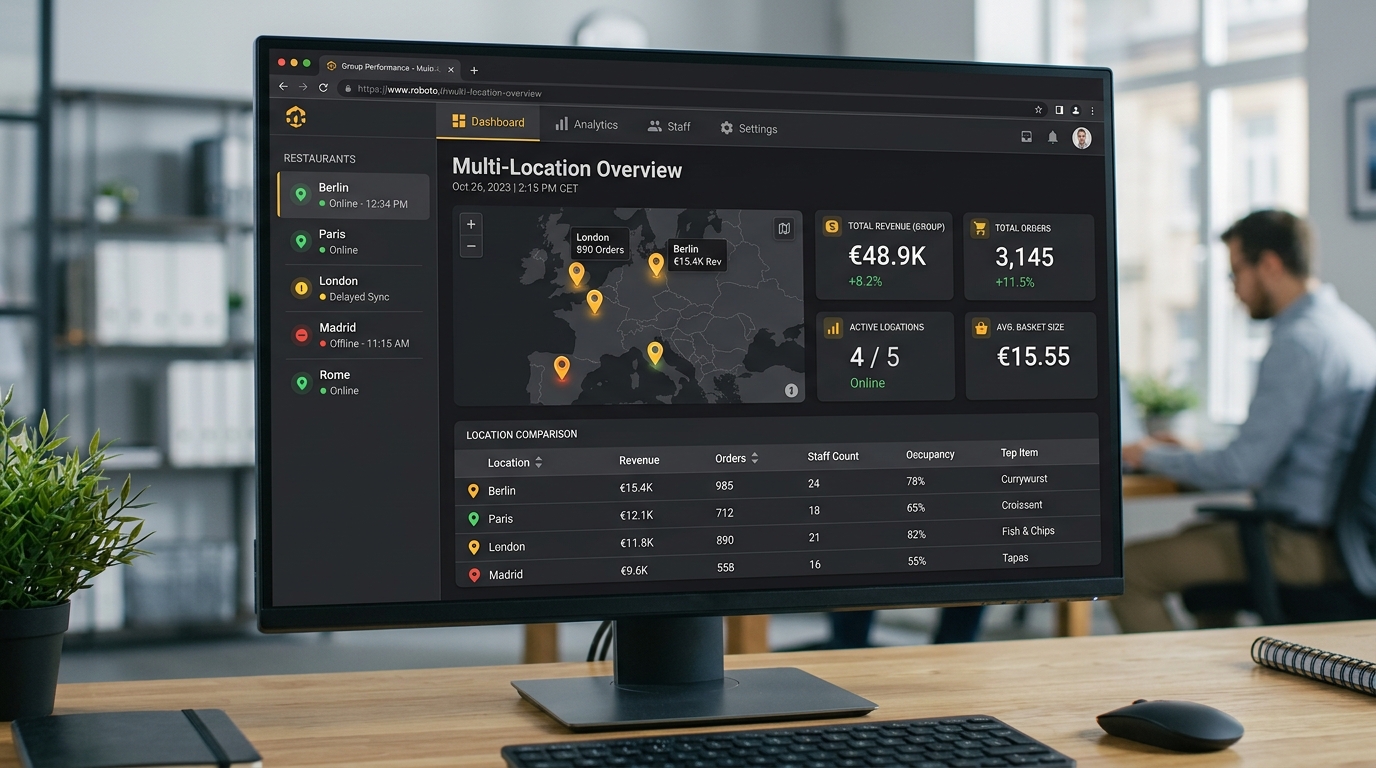
Opening a second restaurant location is one of the most exciting milestones in hospitality — and one of the most common ways a successful single-site operator quietly loses control. The first site often runs on informal knowledge: the owner knows every supplier, the head chef adjusts the menu by instinct, and the manager handles exceptions without a written process. That works at one address. It breaks the moment you are trying to run two kitchens, two teams, and two sets of customers who each expect the same experience. This article explains why multi-site operations fail in predictable ways, what "one source of truth" actually means in practice, and how growing restaurant groups stay in control without smothering the local flexibility that makes each venue work.
Why the second location breaks single-site habits
At one site, inconsistency is expensive but survivable. A price that was never updated on the QR menu, a void that should have been flagged, a promotion that ran a day too long — these are irritations, not existential threats. At two sites they become patterns. Site A and Site B start drifting apart: different prices for the same dish, different modifier sets, different opening procedures, different ideas of who is allowed to change what. Customers notice before head office does, usually in the form of a complaint or a social post comparing the two experiences.
The underlying problem is not growth itself but the absence of shared infrastructure. Single-site operators often rely on a hero manager or a founder who holds the whole operation in their head. That person cannot be in two places at once, and the tacit knowledge they carry does not scale by being repeated louder in weekly calls. Multi-site success requires making the important things explicit, central where they should be consistent, and local where variation is genuinely valuable.
The shift from one location to many is not really a real-estate decision. It is an operating-system decision: you are choosing whether your second site runs on the same rules, data, and permissions as your first — or whether it becomes a cousin that only looks related from a distance.
One source of truth for menus and pricing
The most visible form of drift between locations is the menu. In a disconnected setup, each site maintains its own spreadsheet, its own POS category tree, its own QR menu link, and perhaps its own signage playlist. A price change in one system does not automatically flow to the others, so the customer at the counter, the customer scanning a QR code, and the customer reading the wall board can all see different numbers for the same item. That is not a minor branding issue; in regulated markets it can be a compliance problem when displayed prices do not match what the till charges.
A healthier model treats the menu as a central asset with controlled local overrides. Head office defines the core catalogue — items, descriptions, allergens, base prices, and tax categories — and each location inherits that baseline. Local managers might toggle availability, run a permitted local special, or adjust hours, but they do not maintain a parallel menu universe. Every customer-facing surface reads from the same dataset: POS, QR ordering, kitchen display, and digital signage.
- Central catalogue. One definition of each item, maintained once, propagated everywhere it is sold.
- Controlled local exceptions. Clear rules for what a site manager can change without head-office approval.
- Automatic propagation. When a price or allergen tag updates centrally, every channel at every site reflects it without a separate update project.
- Audit trail. Who changed what, when, and at which location — essential once more than one person can edit.
The goal is not to run every site identically; it is to make differences deliberate rather than accidental.
Central control versus local flexibility
Operators sometimes fear that centralisation will flatten the character of individual sites. In practice, the opposite is more common: without central guardrails, local teams improvise in ways that erode margin and brand. The workable compromise is to centralise what customers should experience consistently — core menu structure, pricing bands, allergen information, fiscal settings — and decentralise what genuinely benefits from local judgment, such as daily specials within an approved template, staffing levels, and floor layout. The technology should make the boundary visible: local users see what they are allowed to change and what is locked, rather than guessing and hoping.
Staff roles, permissions, and accountability
Menus are only half the control problem. The other half is people. At scale, you need to answer simple questions with confidence: who can void an order, who can apply a discount above a threshold, who can edit prices, who can see group-level financial reports, and who can only see their own site. Single-site restaurants often run on trust and proximity; multi-site groups cannot.
Role-based permissions turn informal trust into enforceable policy. A floor supervisor might be able to comp a drink within a limit; a regional manager might approve a larger adjustment; only head office might change base prices or tax settings. Void and refund patterns that look normal at one site but anomalous at another become visible when permissions and logs are consistent across the group.
- Role templates. Define standard roles once — server, shift lead, site manager, regional ops — and apply them to every location.
- Least privilege. Give each role only the access it needs; escalate exceptions rather than handing everyone admin keys.
- Cross-site assignment. For groups that move staff between sites, permissions should follow the person or reset cleanly per site, not linger as orphaned access.
- Review cadence. Quarterly permission audits catch the slow creep of "temporary" admin access that never got revoked.
Good permissions do not replace culture, but they protect culture when you are not in the building — which, at two sites or twenty, is most of the time.
Comparing locations fairly
Once you have more than one site, leadership conversations shift from "how did we do today?" to "which site is actually performing, and why?" That second question is surprisingly hard to answer when each location records data differently, uses different tender types, or runs different promotional calendars. Fair comparison requires normalised metrics collected the same way everywhere.
Start with a small set of numbers every site reports in the same definition: net sales, average ticket, covers or orders, labour cost as a percentage of sales, void and refund rates, and direct-channel share versus marketplace orders where relevant. Resist the temptation to compare sites on raw revenue alone; a high-street flagship will naturally outsell a suburban branch, but the suburban branch might have better margin and lower labour intensity. Normalise by covers, by seat, or by operating hours when you want to understand efficiency rather than sheer volume.
You cannot manage a group from a pile of incompatible spreadsheets. Multi-site reporting only works when every location speaks the same metric language — and when head office trusts the numbers enough to act on them.
Dashboards that drive action, not anxiety
The best group dashboards are boring in a good way: they show the same charts for every site, highlight variance from the group's own baseline rather than arbitrary targets, and make it obvious when a location needs a visit versus when it needs a menu tweak. A sudden spike in voids at one site is a coaching conversation; a sustained drop in direct-order share across several sites is a strategy conversation. The dashboard should route each signal to the right conversation instead of dumping everything into one unreadable wall of green and red.
Fiscal compliance at scale
Compliance complexity multiplies with geography. A group with sites in two countries — or even two regions with different fiscal rules — cannot treat tax and receipting as a local afterthought. Each location needs the correct VAT treatment, the correct fiscal device or cloud signing configuration, and the correct reporting cadence for its jurisdiction. Head office needs a view of compliance health across the estate without reading every country's tax code at every board meeting.
This article will not replay the full European fiscal landscape; a dedicated treatment of AI-assisted VAT classification and audit readiness belongs elsewhere. The multi-site point is narrower: compliance must be configured per location, monitored centrally, and never dependent on whichever manager happened to remember the local rule. When a new site opens, fiscal setup should be a checklist step in the rollout playbook, not a panicked week-before-opening scramble.
A practical rollout playbook for location N
Every new site should follow the same sequence, refined after each opening. A workable template looks like this:
- Clone, do not reinvent. Start from a proven site template: menu structure, roles, tender types, receipt format, and signage layout. Customise only what the new market or format genuinely requires.
- Configure fiscal and payments first. Before training staff on table numbers, ensure the location's tax profile, signing method, and payout account are correct and tested with dummy transactions.
- Train on the live system. Run a soft opening on production configuration with friends-and-family service so managers learn voids, transfers, and end-of-day on the real tools.
- Verify every customer surface. Walk the room: scan the QR code, read the wall board, place an order at the counter, and confirm kitchen tickets and receipts match the central menu.
- Set a 30-day review. Compare the new site's void rate, average ticket, and labour percentage to sister sites in the same format. Intervene early if variance suggests training gaps or menu misconfiguration.
Document what differed at this opening and feed it back into the template. Location five should be easier than location two because the playbook learned from location two's mistakes.
Where Nigmet fits
Nigmet is an AI-native restaurant operating system built for operators who outgrow single-site tooling. Menus, pricing, allergens, and availability are maintained centrally and flow automatically to POS, QR ordering, kitchen display, and digital signage at every site. Staff roles and permissions are defined once and assigned per location, so a regional manager sees group reporting while a shift lead at one site cannot change prices at another. Analytics compare locations on the same definitions, and fiscal compliance tooling tracks per-site health so expansion does not mean flying blind into a new jurisdiction. The aim is not to replace local managers but to give them a consistent foundation so their judgment applies to hospitality, not to fixing duplicated data.
Metrics that matter for restaurant groups
Groups that scale well track a short list of numbers relentlessly:
- Contribution margin per site. Revenue minus variable costs, comparable across locations after normalising for format differences.
- Labour percentage. Labour cost divided by net sales, watched weekly; sudden divergence often signals scheduling or training issues.
- Direct-channel share. The percentage of orders through channels the group owns; especially important if any site still leans on marketplaces.
- Void and refund rates. Early indicators of training gaps, fraud risk, or menu/configuration problems.
- Compliance health. A per-location view of fiscal configuration completeness — not glamorous, but cheaper than an audit surprise.
- Time-to-publish menu changes. How long it takes a central price update to be live everywhere; long lag means you still have hidden manual steps.
Review these monthly at group level and weekly at site level. The cadence matters more than the sophistication of the dashboard.
Common failure modes to avoid
Multi-site groups tend to fail in a handful of repeatable ways. Recognising them early saves years of unwinding bad habits.
- Letting each site pick its own software. "Best of breed" per location feels pragmatic but destroys comparability and doubles integration work.
- Founder-as-router. Every decision still flows through one person; growth stalls when that person becomes the bottleneck.
- Menu anarchy. Local chefs or managers maintain shadow menus outside the central system; customers and compliance both suffer.
- Reporting theatre. Beautiful dashboards that nobody trusts because the underlying data is inconsistent.
- Compliance debt. Opening sites quickly and fixing fiscal configuration later — the fix rarely happens before something painful does.
None of these require exotic technology to avoid; they require discipline and a platform that makes the disciplined path the easy path.
The bottom line
Opening location two without breaking location one is less about working harder and more about working on shared infrastructure: one menu truth, clear permissions, comparable reporting, and per-site compliance that head office can see at a glance. The restaurants that scale well are not necessarily the ones with the most charismatic founders; they are the ones that turn tacit single-site knowledge into explicit multi-site systems before the complexity outruns their attention.
If you are planning a second site — or trying to regain control of a group that grew faster than its processes — start by auditing where your menus, permissions, and metrics actually live today. The gaps you find are the roadmap. Close them deliberately, one layer at a time, and each new opening becomes an exercise in execution rather than reinvention.
Ready to run every location from one platform? Explore multi-site plans and transparent pricing on our pricing page.