Title
Excerpt
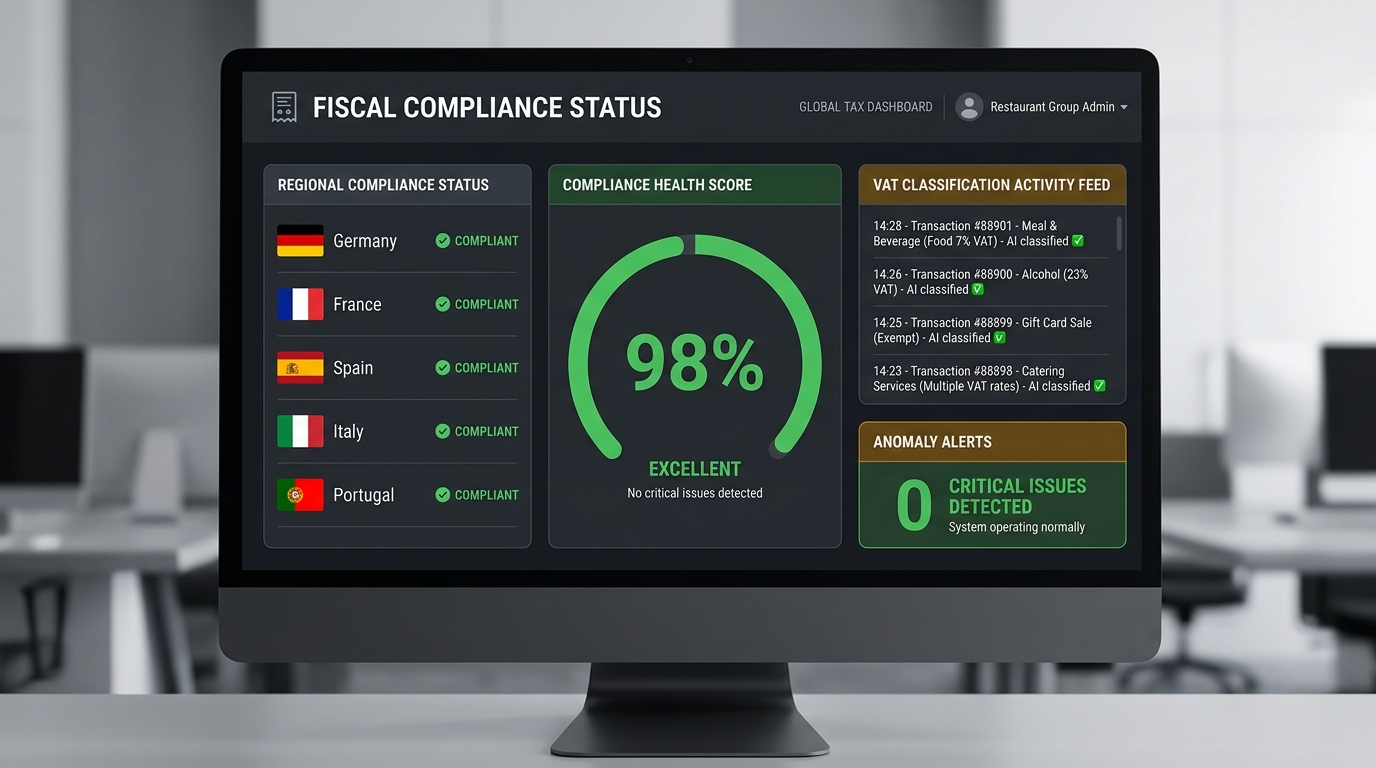
Fiscal compliance is the part of running a restaurant that nobody opens a restaurant to do — and yet getting it wrong can be more damaging than a bad review or a slow month. Across Europe, tax authorities have spent the last decade tightening the rules around how sales are recorded, receipted, and reported, precisely because hospitality has historically been a high-risk sector for under-reporting. This article explains what modern fiscal compliance actually requires, why it has become so complex, and how an AI-assisted compliance engine can turn a source of constant anxiety into something that mostly runs itself.
What "fiscal compliance" covers
Fiscal compliance is broader than "paying your taxes." For a restaurant it spans several overlapping obligations, and the exact shape varies significantly by country:
- VAT / sales tax. Charging the correct rate on each item, tracking input and output VAT, and filing accurate periodic returns. Food and drink frequently attract different rates, and the rate can even depend on whether an item is eaten in or taken away.
- Fiscalisation. Many European countries legally require that point-of-sale systems record each transaction in a tamper-evident way — often via certified fiscal devices, secure signatures, or government-registered records — to prevent sales being deleted after the fact.
- Receipt and invoice rules. Mandatory receipt contents, sequential numbering, and increasingly electronic invoicing and real-time or near-real-time reporting to tax authorities.
- Record retention. Keeping compliant, auditable records for a legally mandated number of years.
- Anti-fraud controls. Rules specifically designed to make it hard to hide cash sales or manipulate totals.
Each of these is individually manageable. The difficulty is that they interact, they differ by jurisdiction, and they change.
Why compliance became so complex
Three forces have made fiscal compliance dramatically harder over the last decade.
1. The digitisation of tax authorities
Tax administrations across Europe have modernised aggressively. The broad trend is toward real-time or near-real-time visibility: instead of a business self-reporting totals months later, authorities increasingly want structured transaction data at or close to the moment of sale. This closes the window for after-the-fact manipulation but raises the technical bar for merchants, who now need systems that can produce compliant structured records automatically.
2. Fragmentation across borders
The European Union harmonises some VAT principles, but the practical implementation — rates, fiscalisation hardware or software requirements, e-invoicing mandates, receipt formats, and reporting schedules — is set nationally and differs widely. An operator with locations in more than one country faces several distinct compliance regimes at once. Even a single-country operator must track that country's specific and evolving rules.
3. Constant change
Rates change. E-invoicing mandates roll out on staggered timelines. New anti-fraud requirements appear. Compliance is not a one-time setup; it is a moving target, and falling behind is easy when your actual job is running a kitchen.
The modern reality is that fiscal compliance is a software problem. The rules now assume that your point-of-sale can produce structured, tamper-evident, correctly-taxed records automatically — which means the quality of your system directly determines your compliance risk.
A tour of European fiscal regimes
The abstract point about fragmentation becomes concrete when you look at how different countries have implemented anti-fraud and reporting rules. The following are well-known examples of the diversity operators face; the specifics evolve over time and this is not legal advice, but the pattern illustrates why a one-size-fits-all approach fails.
- Germany has required that point-of-sale systems be protected by certified technical security equipment (commonly referred to under the KassenSichV cash-register security ordinance), designed to make transaction records tamper-evident, alongside long-standing digital record-keeping principles (GoBD).
- France has required that certified point-of-sale software meet anti-fraud standards (widely known via the NF525 certification), ensuring records cannot be altered after the fact.
- Italy has moved toward electronic transmission of daily receipts to the tax authority and operates a national electronic-invoicing exchange system (the Sistema di Interscambio, or SdI) through which invoices are routed.
- Portugal has long required certified invoicing software and structured audit files (SAF-T), with invoices carrying validation codes and QR codes for verification.
- Poland uses standardised audit files (JPK, a SAF-T variant) and has been rolling out a national e-invoicing platform (KSeF).
- Spain features regional and national initiatives around certified billing and near-real-time reporting, reflecting how even a single country can layer multiple regimes.
- Austria has required signature-based tamper protection for cash registers (RKSV).
Notice the common direction of travel beneath the national variety: tamper-evident records at the point of sale, structured data the authority can ingest, and increasingly electronic invoicing routed through or reported to government systems. A restaurant operating in one country must satisfy that country's specific implementation; a group operating across borders must satisfy several at once, each with its own certification, file format, and reporting cadence.
The shift to e-invoicing and digital reporting
The biggest structural change on the horizon is the move toward mandatory electronic invoicing and digital reporting across the European Union. Broadly, the direction — reflected in the EU's "VAT in the Digital Age" (ViDA) agenda and in numerous national mandates — is away from periodic self-reported summaries and toward structured, machine-readable invoices and near-real-time transaction reporting. For restaurants, the practical implication is that ad-hoc, manual, or spreadsheet-based processes will not satisfy these requirements. The systems that record sales will need to emit compliant structured documents automatically, on the schedule and in the format each jurisdiction demands. This is not a distant concern; the transition is already underway in many markets, on staggered timelines, and the safest posture is to run on infrastructure built to keep pace with it.
The cost of getting it wrong
Non-compliance is not a paperwork nuisance; it carries real consequences: financial penalties, interest on underpaid tax, the cost and disruption of audits, and in serious cases business-threatening liability. Beyond the direct penalties, compliance failures consume enormous management attention and create chronic background stress. Many operators over-provision for this by paying for extensive manual bookkeeping and accountancy simply to feel safe — a real cost that scales badly.
Where VAT specifically trips restaurants up
VAT deserves special attention because food service is unusually exposed to its edge cases. The correct rate can depend on the nature of the item (basic foodstuff versus prepared meal versus alcohol), the context of consumption (dine-in versus takeaway), and country-specific carve-outs. A single order can contain items at multiple rates. Applying these correctly by hand, transaction after transaction, is error-prone; applying them automatically at the point of sale, driven by rules that know the current rates and the consumption context, is exactly the kind of task software should own.
What an AI-powered compliance engine does
"AI-powered" should mean something concrete, not a marketing sticker. In compliance, machine intelligence earns its keep on a specific set of jobs where rules are complex, context-dependent, and constantly changing:
- Automatic tax classification. Determining the correct VAT rate for each item based on its category and the consumption context, so mixed-rate orders are handled correctly without manual intervention.
- Real-time validation. Checking each transaction against the applicable rules as it happens and flagging anomalies before they become filed errors.
- Jurisdiction awareness. Applying the right country's rules to the right location, and keeping those rule sets current as regulations change.
- Structured record generation. Producing tamper-evident, correctly formatted receipts, invoices, and reporting files that satisfy fiscalisation and e-invoicing requirements automatically.
- Anomaly detection. Surfacing patterns that look like errors or risks — the kind of review an auditor would do — so problems are caught internally first.
- Advisor tooling. Giving the restaurant's accountant clean, structured, exportable data instead of a shoebox of receipts, which shortens and de-risks the professional relationship.
The unifying idea is that compliance should be a byproduct of ringing up a sale correctly, not a separate month-end scramble. When the rules live in the system and apply automatically at the moment of transaction, the records are compliant by construction.
Why this belongs in the POS, not bolted on afterward
A recurring mistake is treating compliance as something that happens later — exported to a spreadsheet and cleaned up by an accountant after the fact. That approach is fragile because the raw data is often already wrong or incomplete by the time it is reviewed. The robust approach embeds compliance at the point of sale: the moment an order is taken, the correct rates are applied, the transaction is recorded in a tamper-evident form, and the compliant receipt is issued. Everything downstream — reporting, filing, audit — then draws from a clean, authoritative source.
This is also why compliance and payments should share infrastructure. When the money that settles to your bank is reconciled against records that were compliant at the moment of sale, the entire chain from customer payment to tax filing is consistent, with no gap for errors to creep in.
Where Nigmet fits
Nigmet is an AI-native restaurant operating system with fiscal compliance built into its core rather than added as an afterthought. Because POS, payments, and compliance are one platform, each transaction is taxed at the correct rate for its items and consumption context, recorded in a tamper-evident form, and receipted in a compliant format at the moment of sale — across the European jurisdictions Nigmet supports, with rules maintained as regulations evolve. The platform surfaces anomalies for internal review and produces clean, structured, exportable records for accountants and auditors. The goal is straightforward: make correct compliance the default outcome of normal operation, so operators spend their attention on food and guests rather than on tax mechanics.
Under the hood: where machine intelligence genuinely helps
It is worth being precise about what "AI" contributes here, because the phrase is overused. Compliance is not a domain where you want a black box guessing; you want deterministic rules applied reliably, with intelligence layered where judgement and pattern-recognition add value. The realistic division of labour looks like this:
- Rules engines handle the deterministic core. VAT rates, receipt formats, and fiscalisation requirements are rules, not guesses. The system encodes the current rules per jurisdiction and applies them exactly.
- Machine learning helps with classification and ambiguity. Deciding the correct tax treatment of a new or unusual menu item, mapping a product to the right category, or inferring consumption context can benefit from models trained on many examples — with human review for edge cases.
- Anomaly detection surfaces risk. Statistical and pattern-based monitoring flags transactions or trends that look like errors or irregularities — the kind of review an auditor performs — so problems are caught internally before they reach a filing.
- Automation keeps rules current. When a rate or mandate changes, the system's rule set is updated centrally, so every location is compliant without each operator tracking the change themselves.
The goal is reliability with intelligence in support, not intelligence in place of reliability. Compliance that is "probably right" is not compliance.
The audit trail and record integrity
At the heart of modern fiscalisation is a single idea: records must be tamper-evident. A tax authority's core fear is that a sale is rung up, cash is taken, and the record is later deleted or altered so the revenue disappears. Anti-fraud regimes counter this by requiring that each transaction be sealed — signed, chained, or registered — in a way that makes after-the-fact alteration detectable. A compliant system therefore does not simply store sales; it creates an immutable, sequential, verifiable audit trail. When an auditor arrives, the ability to produce a complete, consistent, tamper-evident history of every transaction is what turns a potentially fraught audit into a routine one. This is precisely the kind of guarantee that is nearly impossible to provide with manual records and spreadsheets, and straightforward to provide with a system designed for it.
The accountant relationship, transformed
Fiscal compliance does not eliminate the need for a good accountant — it makes that relationship far more productive. When the underlying data is clean, structured, and exportable, your accountant spends their time on advice and strategy rather than on cleaning up messy records. Instead of reconstructing what happened from a shoebox of receipts, they receive authoritative data and can focus on optimising, planning, and filing. This tends to reduce professional fees or, at least, redirect them toward higher-value work — and it dramatically reduces the risk that an error slips through because the source data was unreliable.
The hidden cost of do-it-yourself compliance
Many operators, especially smaller ones, try to manage compliance manually or with generic tools, reasoning that it saves money. In practice this is often the most expensive path once you account for the full cost: the owner's or manager's time spent wrestling with rules that are not their expertise; the professional fees to correct and file; the ever-present risk of penalties from an honest mistake; and the opportunity cost of attention diverted from running the restaurant. Manual compliance also scales terribly — it is merely painful for one location and becomes untenable across several, particularly across borders. Building the capability into the system that already records your sales converts a recurring, error-prone chore into a background process.
Multi-entity and cross-border operators
For groups operating multiple locations — especially across countries — the compliance challenge multiplies rather than adds. Each jurisdiction has its own rates, formats, and reporting obligations, and consolidating them for group-level reporting is its own task. A platform that handles the local rules per location while rolling data up to a consolidated view removes an enormous amount of manual coordination. The alternative — a different local system in each country, manually reconciled — is exactly the kind of fragile, labour-intensive setup that produces both errors and stress at scale.
How to evaluate a compliance capability
Compliance claims are easy to make and hard to verify, so probe them:
- Which jurisdictions are actually supported, and how are their specific fiscalisation and e-invoicing rules handled?
- How are VAT rates and consumption context applied at the item level, including mixed-rate orders?
- How are records made tamper-evident, and do they satisfy local fiscalisation requirements?
- How does the system stay current when rates or mandates change — is it automatic, or does it depend on you?
- What can you export for your accountant and for an audit, and in what format?
- How are anomalies surfaced so you catch issues before the authorities do?
The bottom line
Fiscal compliance has quietly become one of the hardest technical demands placed on restaurants, driven by digitised tax authorities, cross-border fragmentation, and rules that never stop changing. Treating it as a month-end chore is both stressful and risky. The durable solution is to embed compliance at the point of sale, so correctly-taxed, tamper-evident, properly-formatted records are generated automatically as a natural consequence of doing business — with machine intelligence handling the classification, validation, and monitoring that are too complex and too dynamic for manual effort. Done right, compliance stops being a source of anxiety and becomes something you simply trust is happening in the background.
Want compliance that runs itself? See how the fiscal engine is included across regions and plans on our pricing page.